
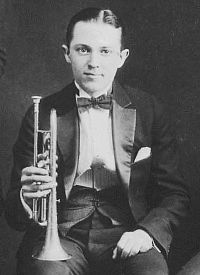
I thought I’d take it easy today by simply writing a short (for me) blurb on my favorite tune with legendary cornet player Bix Beiderbecke. Bix wasn’t hugely famous in his day but was a highly regarded musician, working with many of the best and highest paying white jazz outfits of the time. It wasn’t until years after his untimely death at age 28 that he began to be revered as one of the two most important figures in the history of early jazz, along with Louis Armstrong of course.
I won’t go into Beiderbecke’s biography here, but it is interesting to compare and contrast the sound and styles of these two musicians. Armstrong also played cornet early on, which is a somewhat rounder and mellower toned instrument than the trumpet, but the differences between he and Bix were pretty obvious. Armstrong was a flashier player, especially on stage, stretching the limits of his instrument to its highest registers and playing in a less controlled manner than Beiderbecke. Bix on the other hand was more precise and subtle, with a tone that was buttery smooth, “like a girl saying yes”, in the words of bandleader/banjo/guitar player Eddie Condon. Mezz Mezzrow used the term “militaristic” to describe his cornet style. Bix stayed in the the middle register of his instrument more than Louis and liked to play with phrasing and harmony in different, more understated ways. It was often a less is more kinda thing, with Bix’s tone beautiful enough to make riding a few midrange notes magical.
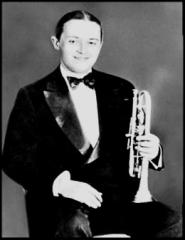
I should add that Beiderbecke also played piano, and wrote and played one of the most challenging and harmonically complex pieces of the early jazz age, “In a Mist”, informed by his love of modern classical composers like Ravel and Debussy. Bix played piano like he did cornet, in a largely self taught way with unorthodox fingerings and unusual harmonies. “In a Mist” is a forward looking piano masterpiece, but far different than most of his work.
If you do any reading about Beiderbecke you’ll find that most people point to two tunes as his greatest achievements, “Singin’ the Blues” and “I’m Coming Virginia”. Both have finely crafted, ahead of their time solos, but I think the piece I’ve chosen today stands up better as a complete piece of music. I’m not sure that Bix saw himself as a soloist, certainly not in the Armstrong vein, though he did worship Louis. He’s able to do it creatively when called upon but it sounds to me like he’s really enjoying himself when there’s more of a back and forth between players. He had a deep and abiding love of New Orleans jazz music even if he was listening to impressionist composers in his spare time. Back and forth between musicians that speak the same language was what New Orleans jazz was all about.
But enough of that… I really just wanna foam at the mouth about this one tune from 1927 that I’ve loved to pieces since I first heard it as a teenager. “At the Jazz Band Ball” has just six guys playing, but man does it sound like a whole bunch more. It’s firmly in that New Orleans tradition in which the whole is greater than the sum of its parts, with players finishing each other’s musical sentences and an emphasis on ensemble playing rather than solos. Not that there aren’t a few solos, but none are by Bix, who picks his spots so well that it seems like he’s soloing throughout the ensemble sections. It’s as perfect a piece of New Orleans jazz, of music in general, as I’ve ever heard. I like it better than the more revered and famous stuff by Armstrong or Kid Ory or King Oliver, but I’m weird like that. It just sounds more flawlessly played, and certainly better recorded.
I’ll digress by saying I do like Jelly-Roll Morton quite a bit though. There’s a lot of progress being made if you listen year by year to his catalog. I see Morton as the Ellington of New Orleans, before there was even an Ellington! Have a listen to some Jelly if you like this, maybe “The Pearls”.
Back to the topic, the personnel on this recording is as follows:
- Bix Beiderbecke (cornet)
- Bill Rank (trombone)
- Don Murray (clarinet)
- Frank Signorelli (piano)
- Adrian Rollini (bass saxophone)
- Chauncey Morehouse (very weird “drums” that typically included what look like turtle shells).
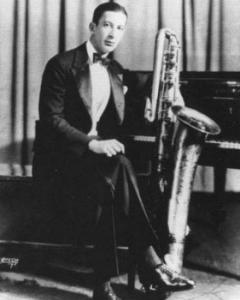
That’s it. The standout musicians are Bix and the phenomenal Rollini, who played seemingly dozens of instruments (including something called a “hot fountain pen”) on hundreds of sessions during this era. The bass sax is by far my favorite from Rollini’s arsenal, and here it’s sneaky great. He’s providing the bass line, a fun and very musically strong solo, and even some smart comping during the peaceful oasis that is the piano solo. The clarinet’s grown on me over the years. A little squeaky at times, but a lot of sentence-finishing, and a well played solo.. I love the quiet to brash changes in dynamic after the solos. The key here though is the ensemble thing. All the parts fit together so well during the non-solo parts, like perfectly jigsawn and polished pieces of a simple but beautiful puzzle.
But Bix is the leader here, even without a solo per say. Within the first minute he’s casually tossed off a few cascading flourishes, one within the first 15 seconds, that are astoundingly speedy for the era, and in perfect time rhythmically, with phrasing to die for.
And then there’s his always perfect, extra-dreamy tone, which is really the star here. It’s incredibly agreeable to the ear, mine at least. He’s doing pretty simple stuff most of the time, but with such subtlety of phrasing and enough harmonic flair to reward repeat listening. I must be well into the thousands by now.
It’s simply amazing how Bix can make such seemingly simple playing so richly satisfying, and the way his lines relate musically with the rest of what’s going on is evidence of a deep knowledge of this style.
I like to listen to this a few times in one sitting, focusing on a different instrument each time through. The trombone for instance is barely noticeable at first, but does some really cool stuff. Same thing for the bass saxophone, playing a rock solid and highly inventive bottom and adding little grace notes here and there. I just can’t say enough about how much I love this little three minute slice of musical heaven!
I guess that’s enough though… I’ve done run out of flowery adjectives or other means of hyperbole. So without further long winded enthusiasm, here’s Bix and His Gang. What do you say? Crips? Bloods? Are those even the teams now? The word gang back then was probably even more likely to be seen as a negative than today


Leave a Reply