
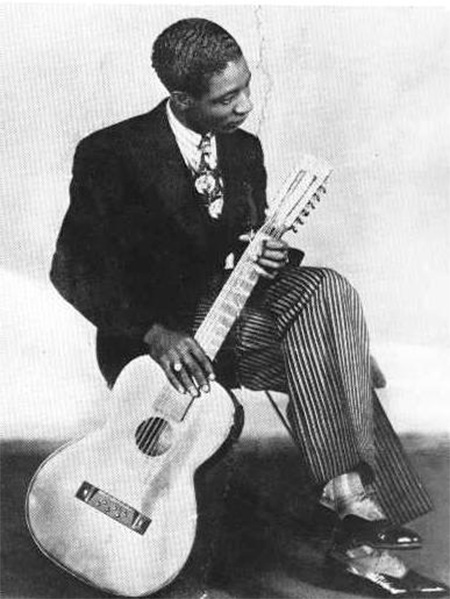
I’ve always been a big fan of guitarist/blues legend Lonnie Johnson, most often labeled a blues guy but really he was a true musician, serious about it and able to easily play other things like the jazz of the era, probably some comedic/vaudeville type tunes, hillbilly shit or what we now label as “folk” or country, etc.
He could play pretty much anything because he was an immensely talented musician, playing multiple instruments, eventually settling on guitars, including the odd choice to use a 12 string during his heyday. It was on that 12 string that he recorded the duets with Eddie Lang in 1929, basically inventing lead guitar as we know it, or putting it on record first anyway. Undoubtedly people had been doing it since guitars were invented, but not like this.
Lonnie’s the first to really bring the possibilities to life. There are riffs here that everyone still plays! They probably predate even Lonnie, just hadn’t been recorded yet
Lonnie was a pretty big blues star for a few years during the mid-late 1920s. He must have sold well because they kept wanting more – he cut a lot of sides! He was best known at the time as a singer, to the public anyway. I’m sure his guitar and vocal skills were being recognized by fellow musicians. He was the original musician’s musician in the blues realm of the 20s and beyond, but I’m just here to talk about this one tune, “Handful of Riffs”.
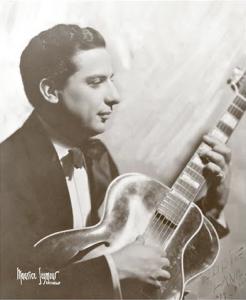
Lang and Johnson recorded over a dozen tracks together with no other accompaniment, landmark recordings of two worlds coming together musically, each being improved by the other. Too bad it doesn’t work like that in every aspect of life. They released the recordings done with more accompanists as by Blind Willie Dunn’s Gin Bottle Four, so as to disguise the presence of Lang amidst so many not-white musicians, you know the ones. The ones making the breakthroughs and guiding the way forward for jazz and pop culture at large, as is largely true even now. It’s always been the white folks playing catch-up to the creativity of those of color, probably always will be.
Anyway, the performance here speaks for itself. If you haven’t yet heard it and play guitar or like guitar or maybe think you’re a guitar you’re in for a treat! This is like ground zero for several guitar licks and is pretty much non-stop Lonnie soloing on that 12 string guitar, bending notes and going fast, perfectly in tune too!
See, that shouldn’t be possible. 12 string acoustic guitars even today, with space age materials like heavy duty plywood being used, are often a nightmare to get in tune, let alone play in tune up the neck. This old Stella or whatever it is that Lonnie’s using seems not to suffer from any tuning issues at all! Unheard of!
Really it’s Lonnie’s skill and the fact that his guitar must have been expertly worked on to be that in tune. Anyone can do it but it’s kind of a science with magic added kinda thing. Lonnie’s from New Orleans, so voodoo has to be considered. You never know…
Whatever it was I’m happy that guitar played so well for him because I fucking love this tune. Over the years I’ve played it probably thousands of times by now. There’s this one part (it starts at 1:02) that gives me goose bumps every time. He wiggles a note after having done something different the previous few times, a surprise wiggle when you thought he was gonna waggle! I’ve always loved that bit!
And as someone that still owns a 12 string and could at one time play a half-assed version of Leo Kottke’s “Watermelon”, wiggling a note on a 12 is no easy task. It’s serious finger/hand strength combined with calluses hard as nails. Bending, also impossible, is easy for Lonnie. He’s wiggling AND bending with more finesse and accuracy than 99% of the 6 string wusses of his or any era. The man had some moves…
I’ll cut things short and just foist the tune. I envy any guitarist that hasn’t yet heard it. Turn it up! Feel the swing rhythm ten years before Goodman and Shaw’s chart dominance, the fabs and Stones of the late 30s! Groundbreaking that way too! Enjoy…


Leave a Reply