
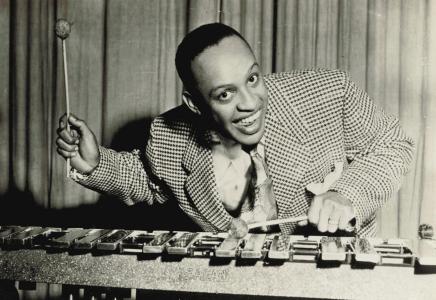
It’s another reheated post from the old tumblr blog, this time from 2015. I’m feeling a little down and needed an easy task. This was it, and it cheered me up nicely I must say, watching the second clip, which wasn’t part of the original. The YT links always get messed up so I have no idea what it was originally without clues. I may have duplicated info in the blurb above Flying Home too, not having fully read the piece yet even now! I’ll do that now as I hand you over to the very cute 55 year old me, still with teeth at that point!
I was gonna use a word like “unknown” or “overlooked” in the title here, but the truth is that Lionel Hampton was and still is a pretty famous name, at least among music geeks. Perhaps not as well known or highly respected as the Louis Armstrongs, the Duke Ellingtons or Count Basies, but I’d argue that while he maybe wasn’t as groundbreaking an artist as any of them, he nevertheless was a major figure in the history and development of 20th century American musics, mainly jazz, but also R&B. He almost singlehandedly pioneered the use of the vibraphone in jazz, beginning in 1930 with Louis Armstrong, played with a who’s who of giants of jazz and R&B – often giving future stars their first big break, and managed to earn a very nice living at it, musically solid yet mainstream enough to become a fixture on the most popular media outlets by the 1940’s.
What prompted me to write about Hampton today was a little digging I did yesterday into who the guitarist on Dinah Washington’s “Long John Blues” was. I’m now convinced that it was John William “Billy” Mackel, who was to Hampton what Freddie Green was to Count Basie, with the added benefit of being a fluent soloist and playing electric guitar very early on. Upon further inspection of some Hampton material I already had, as well as some great information found on various websites, I was struck by how many great players passed through his bands over the years, or otherwise impacted his career. Armstrong of course, Benny Goodman, Teddy Wilson, Gene Krupa (this grouping being one of the first mixed race combos to perform publicly for whites), Art Tatum, Dizzy Gillespie, Charlie Christian, Arnett Cobb, Dexter Gordon, Quincy Jones, Art Farmer, Illinois Jacquet, Clifford Brown, Charles Mingus, Wes Montgomery… The list is practically endless and includes virtually anyone and everyone of note in the jazz and R&B worlds for decades and decades.
One name that I found particularly interesting was Hampton’s xylophone teacher – Jimmy Bertrand. Bertrand played on a few Blind Blake records! It’s truly amazing the time periods and genres spanned by Lionel Hampton’s remarkably long and successful career! One guy, and he personally interacts with Bertrand and, say, Merv Griffin, or any of the other guys on whose TV shows Hampton appeared later in life. Kinda surreal, to me anyway.
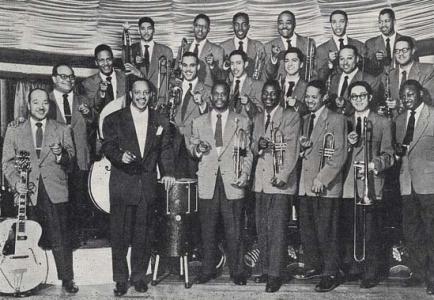
I won’t even try to go into any more detail on Hampton’s history or career, or make sense of much of his material. My personal preference is for the stuff he recorded in the 1940’s and early 1950’s, especially after he pared down the big band and had a decidedly rockin’ R&B feel to his sound. It’s been said that Hampton invented “jump blues”, that lovable precursor to rock and roll, in 1942 with his second (big band this time) recording of “Flying Home”, featuring Illinois Jacquet on sax. This is a landmark piece of jazz or R&B history. Jacquet, 19 at the time, is said to have basically invented the “honking” style on this fast selling and highly influential recording, co-written by Hampton and Benny Goodman for all intents and purposes.
This particular version of “Flying Home” always leaves me wondering what all the fuss was about. It really sounds nothing like rock and roll at all, and the sax only honks briefly. There have been so many re-recordings and live versions done over the years, by Hampton, Jacquet on his own, and many others, including a fine vocal rendition by Ella Fitzgerald, that things get a little murky when it comes to figuring out which was the one that caused all the hubbub back in 1942. I’m gonna include what I’m fairly certain was the big selling and influential version, which is indeed rather tame in light of what’s been written about it over the years, and another, presumably later version credited to Illinois Jacquet and his All Stars that rocks a bit harder, has a smaller band, and has better sax solos, to my ears anyway.
Sorry folks, I’ve found a little offramp in my musical travels and I’m following it where it leads. Figured I’d write a bit about one of the more famous landmarks along the way!
Here’s the big hit, the one that put Lionel on the map, made him a household name for decades. Until reading the piece again just now I forgot I’d introduced it above already. I can hear it more in context now and I understand better why it was so huge. It had to have sounded pretty wild at the time, before its influence spread very very quickly, to the point that within a month everyone sounded like that on sax, and that rhythm never went away either. It just kept evolving until it was suddenly Earl Palmer making Little Richard records sound truly ferocious with that sneaky great backbeat thing he could do. I didn’t fully realize all that back in 2015. Always learning… It will never stop as long as I’m breathing… It’s really the funnest part of everything, right? Knowing more? It is for me at least!
And here’s a real fun clip, from the 1948 film “A Song Is Born,” Lionel Hampton teaches Professor Magenbruch (Benny Goodman) a thing or two about jazz. In color! Louis is there! Danny Kaye, an asshole of a guy but huge back then! Maybe Al Hendrickson on guitar. Charlie Barnet and Tommy Dorsey are there too! The hot gal is Virginia Mayo. I love the whole aesthetic here, the fashion, the colors, everything! The late 40s was an awesome time for everything!!! Unless you were a commie… Or black, but that was rapidly changing, as Lionel’s presence in this blockbuster film makes clear, plus the Indians winning the World Series that year with two black stars before record setting crowds of over 80,000! It wasn’t great, just a little better. We still have a long way to go unfortunately…
——————————-


Leave a Reply