
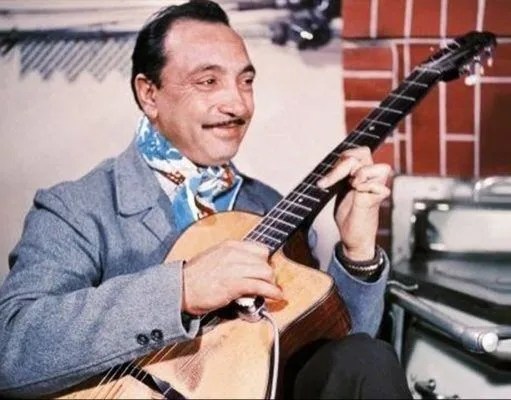
I mention an upcoming larger scale post on Django, but after rereading this a few days later I now realize that I said everything I wanted to say in that one here, so there will be no new Django post in the planned future. I could well do another song however, one of those 1953 tracks where he’s using a guitar that was made to be electric, probably a big Gibson. I can’t tell from the most famous photo. It’s big, with one pickup. Actually, I just looked it up and it was a Levin De Luxe, and was only used in 1946, borrowed from Duke Ellington’s guitarist Fred Guy for a few gigs, then returned. No idea what he used later on, but I’ll look into it! I still think probably Gibson, the most famous and readily available electric you could buy in the 40’s. Fender didn’t happen until the early 50s other than prototypes. Imagine Django playing a Telecaster or Stratocaster! It’s not impossible, just incredibly unlikely. It’ll be a Gibson or some odd European brand like Eko or Selmer, possibly Stromburg or even Rickenbacker!
Anyway, I’ll probably post something tonight, the 25th of September, 2026. Early. Before… Now back to the original post, which I’m pretty happy with! I like my own writing! Does that make me a sociopath? Some other -path? I hope not! I’ve been accused before of -pathiness… And narcissism! That’s a big one! Anyway, here’s the post. You be the judge!
I’ll try to keep the verbiage to a minimum with this one, seeing as how I’m already writing a longer post on Django. Not a biography or anything – there are books for that – just my take on his career after almost 50 years of listening to the guy. It never gets old! There are eras too! He evolved, kept up with things, and was playing some insanely complicated “gypsy”/bebop shit by the late 40s, which everyone should know by now is my favorite era for everything!
I should talk about the tune itself first. “After You’ve Gone” is a little weird musically. It was probably written in the 1910s, and a recording by “flapper” Marion Harris was all the rage in 1919, just as returning soldiers were buying Victrolas after having been exposed to them overseas by the military as a way to keep the troops less terrified. It could very well have been based on something(s) even older, possibly much older. There was an older ditty called “Peg o’ My Heart” (1913) that has the identical first four notes and rhythm, so there’s at least that part that’s stolen, or reused. It was written by a team of black songwriters, J. Layton Turner (composer) and Henry Creamer (lyrics), and first recorded for sales purposes (the songwriters had already made a record of it themselves!) in 1918 as far as we know, but didn’t become a “standard” until the late 20s, when people like Louis Armstrong and Bessie Smith recorded it. Everyone in jazz since then is at least familiar with it. A “standard” in jazz is simply a tune that gets played a lot and was probably written originally for Broadway, which until the jazz age was America’s culture for the most part. The poors made do with the circus, traveling carnivals or medicine shows, or they made their own music. That’s what should be the definition of “folk” music, so that’s a term I always put in quotes. I’ll do a piece on that someday but for now I’ll keep it focused on this one performance by the man I believe to have possibly been the most advanced musical mind humanity has yet produced. More on that after I get out of this long ass paragraph! I looked things up even!
What makes this tune different is its structure. It’s missing some bars in at least one place, which can be confusing at first. It all makes sense though, as you’ll hear. It’s an unusual yet still quite logical framework for Django to go nuts over the top of, and boy oh boy does he do just that! If I had to pick just one guitar solo to last me forever this would be the one, no question about it. Nothing else is close, not even by Django himself. These sessions in Rome in 1949 were special, for one big reason, which anyone can understand.
It was mostly because Django and his friend and most talented musical partner, Stephane Grappelli, were back together again. Not for the first time after their separation during the war, but you can tell from listening to these sessions in Rome that they were both at the top of their games, undoubtedly happy to be making great music together in a locale that was likely new for both. I really should know the details better but it’s been a long time since I read the book and I’m not doing research for this paragraph. All I can say is that there’s a palpable joy overflowing from most of these Rome recordings. They sound like they’re happy, comfortable, and challenging one another, even showing off a little maybe, Django especially, who was a ham by nature. .He’d absorbed a lot of bebop by that time and had always been a player that used all the notes (the Romani/Gypsy notes of despair originally, but now bop too!), one of bop’s great gifts to jazz. The almost-dissonance is refreshing as hell! Too much blues makes you crazy, dulls your senses a little after a while, but a few of these tunes and my brain’s gotten the nutrition it needs to keep going, thrive even!
I’m gonna talk about Stephane a little here. I’m happy I’m old because guess what? I saw him live! In the 70s he did a tour of smaller clubs with just two guitarists as accompaniment. I was at the show at the best venue ever, a small restaurant/bar called Red Creek, known to old jazzers as the place to play in western NY. They booked all the heavies going back into the 60s! I even knew the owner, enough to exchange pleasantries at least. I saw dozens, maybe hundreds of great shows there over the years I was still there. It’s now a franchised sports bar called MacGregor’s, but Red Creek will never be forgotten. There are jazz tunes that use its name in the title! So many stories around Red Creek! Partying with Junior Walker’s All Stars, almost meeting Linda Ronstadt, seeing David Lindley and becoming friendly enough with him that he signed a guitar for me. I still got his tour info sent to me, by mail, until he passed a few years back. Great guy! I met Art Neville there too, got an autograph. One of the Meters! I could go on forever. You’ve seen me do it!
So Stephane…. first off, he was amazing live! Must have been around 80 at least, but still playing like it was 1936! He is to jazz violin what Django is to jazz guitar, the best there ever was. I’ve listened to this stuff all my life and I’m still amazed regularly by both these guys. They can both play anything they want at any moment, and with great speed and clarity. They’ve transcended raw technique on their instruments and moved up into regions few mortals see. Even cats like Parker and Gillespie got nothin’ on these guys!
The two guitarists were English. I’m going by memory and likely wrong but I’ll say it was Martin Taylor and Diz Dizley. Nothing fancy, they knew their roles. Play rhythm behind a living genius of jazz, one of the few left! It was a fantastic show! I took lots of mental pictures! We sat within a few yards of them! Stephane never stopped smiling, the whole show and even afterwards when we tried to get close, shake his hand maybe. He was being mobbed more happily than anyone you’ll ever see! And best of all I was there with my best friend, then and now, Mike. His memory matches up with mine! We’ve talked about it a few times now! I’ve seen a lot of great shows, but this one can’t be topped, ever, for obvious reasons! We saw history in person, and he still sounded like his best stuff, even better! Is that enough hyperbole? I can do more! OK…
I guess I should talk about Django’s solo now, the reason I picked this one. It’s my favorite of all his solos and has been for decades now. I got the very album pictured in the clip, a double with a gatefold and lots of notes, while still in high school. Bought it at the Music Lover’s Shoppe on Monroe avenue out in Brighton, towards the ritzy Pittsford area. That was where I went for strings and other guitar stuff, and they had a small but well curated record section too, no bargain bins whatsoever. Yes friends, I paid full price for this one, probably around 10-12 bucks! I knew it’d be worth it but had no idea just how worth it it was!
This was a great period for Django. He’d been listening to bebop as I mentioned earlier, and he was still playing his amplified acoustic “gypsy”-style guitar, which he was intimately familiar with. He’s pictured with lots of guitars but there was one he used most, which is on all the recordings from the swing era, the 30s into the 40s, and on this stuff too. It wasn’t fancy, and had a pickup as an afterthought, now a necessity. Acoustic wasn’t nearly loud enough to cut though the bluster of the big band era but he liked the one he had, so no electric guitar, yet.
That came in the 50s, and by 1953’s recordings he’s gotten used to it and is crushing it in whole new ways, still identifiable as Django but with even more of the weird dissonant bits. That’s the stuff I’m absorbing now, an era I hadn’t really concentrated on yet, and man! I may have another one of these to write soon!
The solo? Oh yeah! Just listen to it! You’ll see/hear what I do, I hope! It just builds and builds, with so many dazzling flourishes and slurs that you think he’ll get tripped up by but he never does! After all these years I can play the entire thing in my head and it really is the most impressive guitar solo I’ve ever heard. It’s logical yet fiery, perfect yet imperfect, just magically musical! And it all ends so perfectly that you feel that after-Thanksgiving glow of contentment. You’ve just had a very nutritious meal!
Stephane does a great job too of course, with solos just as nutritious, just with fewer of those high nutrition notes. He was slightly closer to mere mortals, but still one of the best jazz improvisors you’ll hear, regardless of instrument . This stuff ain’t for the unserious would-be shredder type. Even trying to play rhythm on this shit ain’t easy! I have trouble even doing the chord changes now, though at one time I could do it. At that time I could even handle “Giant Steps” by Coltrane, notoriously difficult for rhythm players, even pianists. It’s a change every beat, and tough ones too!
Alright, I think I’ve covered everything except the fact that it’s not Django’s fingers that are making us happy. It’s his brain, his remarkable mind, so nimble and creative, so willing and able to take in anything he hears and make it his own. For my money there’s never been a better musician, not that I’ve heard, and I’ve heard a lot. Not everything though. I’m ignorant of entire hemispheres full of people that make music you can’t buy or even download here. Maybe some old lady in Patagonia plays better on her flute thing but I doubt it.
Anyway… It’s time to let the vibrating air do what it does, so please, get some air, then hit that play button, but pay attention! You need to actively listen to get the full range of nutrients into you. You’ll feel it! It’s good for what ails you! Ale sucks for that! Weed and Django!!! That’s the path to enlightenment, not the other road, with all the drunks driving the big trucks with the fucking flags and shit… I promise!
Thanks for reading! Comment if you can bear to, because I wanna know how things will be for you after hearing this! Will you take up beekeeping? Many guitarists do after being made aware of Django… It’s intimidating, impossible, frightening! Yet he did it! So glad I found it early in life! It’s a place I can always go for a jolt of unalloyed joy! You can too! Toucan stew!
Sorry… glitched there! So hit play now! Before it wears off! And you’re welcome! Please come again! If possible… takes time to recover, right? I need a beverage… Frosty root beers all around! Yee haw!!! (clunk)


Leave a comment